

"I don't take photos to remember moments. I take photos to feel them again."
From iPhone snapshots to a Sony α7 V — street, nature, family, and wildlife. Learning to see Sydney differently, one frame at a time.
Albums
Collections by theme and genre — street, wildlife, family, travel, and portraits.

Laneways, harbours, train stations — the city in available light.
40+ photos

Birds at Centennial Park, coastal walks, Blue Mountains fog.
60+ photos

Aadhya and Arjun in their unguarded, unhurried moments.

Chasing the last hour of light across Sydney and beyond.
25+ photos

Friends, family, and faces — the Sony 35mm F1.4 GM at work.

Documenting the immigrant experience through places.
30+ photos
Intro
I'm not a professional photographer. I don't have a studio, I don't shoot weddings for money, and I don't have a portfolio site with moody black backgrounds. What I do have is an obsession with light, a Sony α7 V that rarely leaves my bag, and an eye that's slowly learning to see differently.
Photography found me the way most meaningful things do — accidentally. I was already someone who noticed things: the way Sydney's afternoon light hits the sandstone, the way my daughter's face changes when she's concentrating, the way fog rolls through the Blue Mountains like it has somewhere to be. The camera just gave me a way to hold onto those observations.
As an engineer, I spend my days building systems — logical, structured, deterministic. Photography is the opposite. It's chaos, timing, instinct. A fraction of a second decides everything. You can't debug a missed moment. You can't refactor golden hour. That tension is exactly why I love it.

The best photo is the one you almost didn't take because you left your gear at home. I carry my α7 V everywhere — school runs, grocery trips, walks.
If something makes me pause, I shoot it. The rule of thirds can come later. The feeling can't.
Nobody looks at a photo and thinks "nice f/2.8." Technical mastery serves emotional truth, not the other way around.
Street & Urban
Sydney's laneways, train stations, harbour light
Family & Candid
Aadhya and Arjun in their unguarded moments
Nature & Wildlife
Birds at Centennial Park, coastal walks, Australian landscapes
Travel
Documenting the immigrant experience through places
Origin story
How I went from casual phone snapshots to carrying a mirrorless camera everywhere.

Phase 1
For years, my iPhone was my only camera. Family moments, travel snapshots, the occasional sunset. I never thought of these as "photography." They were just records.
The shift happened in 2022. Walking Bondi to Coogee, the afternoon light hit the cliffs in a way I'd never noticed — amber sandstone, three shades of blue ocean. I took a photo and felt frustrated. The photo was fine. But it didn't feel like what I saw. That frustration was the beginning.

Phase 2
My wife Gouthami had been watching me for months — how I'd stop mid-walk to frame a shot, how I'd spend evenings editing instead of watching TV, how I'd talk about light at dinner.
"You're already a photographer," she said. "You just don't have the right tool yet." That gift didn't just upgrade my gear. It gave me permission to take this seriously. There's a difference between a hobby you dabble in and a passion someone you love believes in enough to invest in.

Phase 3
The camera arrived. I remember holding it, turning it on, and feeling both excited and completely overwhelmed. More settings than I expected.
Week 1: Full Auto. Week 3: Aperture Priority — discovering a lower f-number blurs the background felt like a superpower. Month 2: Manual mode experiments. Month 4: Finding a rhythm. The transition from "operating a camera" to "making photographs."

Phase 4
I shoot almost every day. The camera is always with me. Friends saw my photos and asked if I could shoot their weekend get-together. Then casual portraits. Then a birthday event.
Then came the one that mattered most. I shot Gouthami and Aadhya during golden hour when she was pregnant with Arjun. No studio — just late afternoon sun and someone who loves them holding the camera. Those photos are the best I've ever taken. Not technically. Emotionally.
The kit
Built to capture every story.
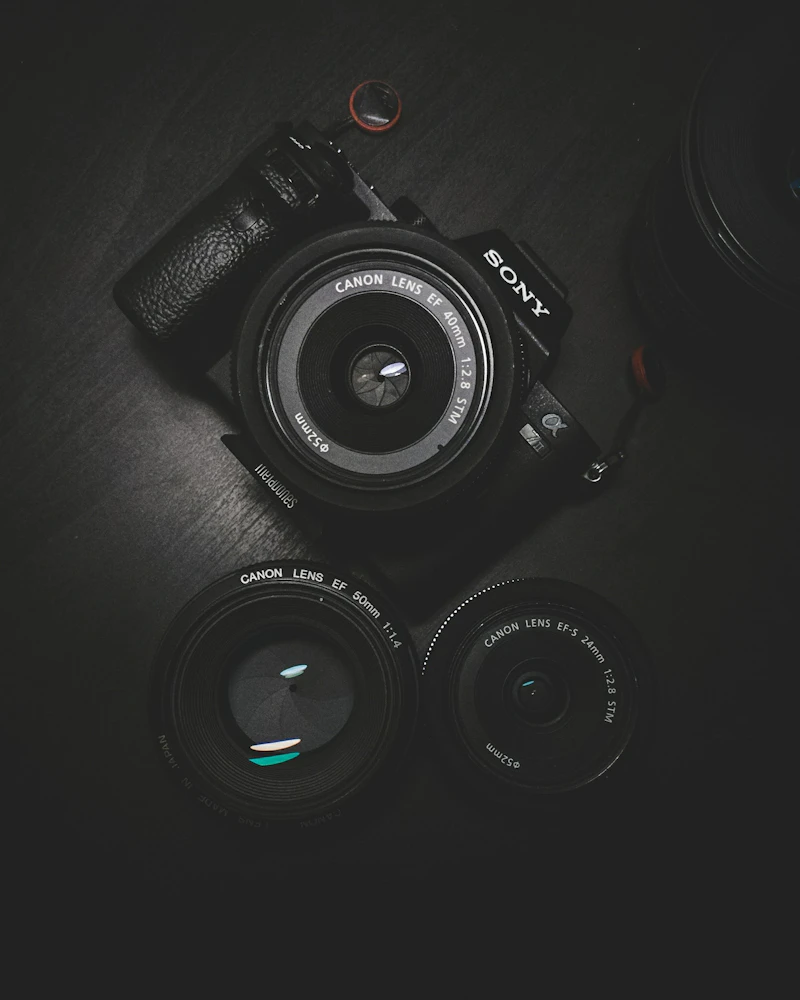
High performance. Ultimate clarity. Engineered for creators.
From wide to wild. I've got you covered.
Events · Travel
All-round excellence
Portraits · Storytelling
Low light mastery
Portraits · Macro · Food
Details that matter
Stage · Weddings · Portraits
Compression & reach
Wildlife · Street · Travel
Go far. Get closer.
Extend your reach
Capture more.
DJI RS 5 Combo
3-axis gimbal stabiliser for smooth, cinematic motion. The combo kit includes follow focus and additional accessories.
Rode VideoMicro II
Ultra-compact directional microphone. Clean audio for run-and-gun video straight out of the hot shoe.
DJI Pocket (4K Video)
Pocket-sized. Powerful. Perfect for cinematic storytelling on the go.
DJI Osmo Mobile 6
Stabilised mobile shots anytime, anywhere.
Shape the light. Elevate the story.
Amaran Ace 25x
Bi-colour LED panel (2700K–6500K). Even, flattering light with precise colour temperature control for portraits and video.
Godox Ring Light
Perfect for macro, product & detail shots.
Godox iT30 Pro
Compact, powerful on-camera flash.
Godox TT350
Versatile speedlite for creative lighting.
Filters (NiSi + Hoya)
Tripod
Stability for every shot.
Lens Bags
Safe storage. Easy travel.
Gimbal
Smooth motion. Cinematic results.
Memory Cards & Card Reader
Fast transfer. Reliable storage.
Power & Backup
3× NP-FZ100 Batteries & Charger
Stay powered. Never miss a moment.
Essentials
Card Reader
Fast transfers from every card.
Cables & Adapters
Keep everything connected.
Craft
Things I wish someone told me when I picked up a camera — technical basics, composition, and the mistakes that taught me the most.
Aperture (depth of field), Shutter Speed (motion), ISO (noise). Three sliders, one brightness. Start with Aperture Priority — you control the aperture, the camera handles the rest.
JPEG is a compressed, processed file — the camera makes decisions for you and throws away data. RAW keeps everything. Recover highlights, lift shadows, fix white balance later.
AF-S for still subjects. AF-C for moving ones. Eye AF for portraits. I shot my first month in AF-S and wondered why photos of the kids were blurry. They don't hold still.
The LCD screen lies in bright sunlight. The histogram tells the truth — bunched left is underexposed, clipping the right edge means blown highlights (unrecoverable).
Auto white balance fails in mixed lighting, golden hour (it "corrects" warm tones you want), and under fluorescents. RAW lets you fix it later, but reading light helps you see color accurately.
I almost lost an entire trip's photos before setting up cloud backups. Two cards. Cloud sync. One copy is no copies.
Your first instinct is to include everything. Fight it. Move your feet. Fill the frame. Most beginner photos improve dramatically by simply getting closer.
A beautiful subject against a cluttered background looks amateur. Before pressing the shutter, scan the edges for distracting bright spots, objects "growing" from your subject's head.
Golden hour: warm, directional, long shadows. Blue hour: cool, moody. Overcast: soft, no harsh shadows — great for portraits. I plan my walks around light now.
The rule of thirds, leading lines, the golden ratio — learn them all. Then forget them when the scene demands it. The best photos often break every rule deliberately.
Mistakes I made so you don't have to
Philosophy
How I think about photographs as stories — single frames that carry narratives, and series that build meaning over time.
I come from a storytelling family. Telugu poetry, oral histories, bedtime tales that stretched longer than they should have. When I picked up a camera, it wasn't long before I started thinking about photos the same way I think about stories.
"A photograph without a story is decoration. A photograph with a story is a document of being alive."

| Who? | Character, identity, presence |
| Where? | Place, context, environment |
| When? | Time, light, season, era |
| What's happening? | Action, tension, the moment |
| What's about to happen? | Anticipation, energy, the unseen |
| How does this feel? | Mood, emotion, atmosphere |
Cartier-Bresson's concept: one fraction of a second when gesture, expression, light, and composition align. Before — not ready. After — it's gone. The hardest photography. But when you catch one, nothing else compares.
A person in their space. The mechanic in their workshop. My daughter in her art corner, surrounded by half-finished drawings. The environment does the storytelling; the person is the anchor.
A series of images that build on each other. Individually they're fine; together they're something. The narrative arc, the beginning-middle-end — this is where photography becomes closest to writing.
A photo doesn't need a subject. Shadows, reflections, textures, patterns. The geometry of a parking garage, the reflection in a puddle after rain. These challenge you to see the world as pure visual information.
Post-processing
How I edit photos across Lightroom (web, mobile) and Snapseed — workflow, philosophy, and the principle that separates processing from manipulation.
"Editing isn't fixing. It's finishing. Ansel Adams spent more time in the darkroom than in the field."
| Context | Tool | Why |
|---|---|---|
| Desktop / serious work | Lightroom (web) | Full RAW editing, presets, sync across devices |
| Phone — quick polish | Lightroom Mobile | Same ecosystem as web, non-destructive, syncs automatically |
| Phone — creative experiments | Snapseed | Local edits, healing brush, more playful |
From camera via USB or SD card reader. Lightroom Mobile for phone shots. Everything ends up in the same library.
Flag picks, reject the obvious misses. I'm ruthless here. A 0.6% keeper rate is fine.
Exposure, contrast, highlights, shadows. Small moves — 5–15 points usually. I rarely touch the extremes.
Often the biggest fix. Use the eyedropper on something neutral when possible. Mixed lighting is the enemy.
Slight warmth in shadows, subtle saturation. I've learned to pull back — my early edits were cartoonish.
Personal presets for "golden hour," "overcast," "indoor warm" get me 80% of the way. I tweak from there.
What I've learned the hard way
Inspirations
You don't find your style by copying. You find it by studying people who make you feel something, then asking why.

"To photograph is to hold one's breath, when all faculties converge to capture fleeting reality."
What draws me
The idea that there's one perfect fraction of a second when geometry, gesture, and light align — and if you're not ready, it's gone forever.
What I've learned
Patience isn't passive. You position yourself, wait, and stay alert. The moment doesn't announce itself — you have to feel it coming. I'm still terrible at this. But studying his work taught me to look for those alignments instead of hoping they'll happen by accident.

"Photography takes an instant out of time, altering life by holding it still."
What draws me
Photography as witness. Not decoration, not aesthetic exercise — documentation of human dignity in impossible circumstances. A single frame can carry the weight of an entire story.
What I've learned
As an immigrant, I'm drawn to people at the edges — not because they're exotic, but because I recognize the in-between. Lange photographed people who were invisible to power. The camera can make people visible, or it can objectify them. The difference is in the intent.
Finding humanity in chaos — war zones, refugee camps, crowded markets — and in the middle of it, a face that stops you.
What draws me
He goes where most of us wouldn't, and comes back with images that feel intimate rather than voyeuristic. The color, the light, the human connection — unmistakably his.
What I've learned
Eye contact changes everything. A portrait where the subject looks at the camera creates a relationship. Looking away creates a different story — observation, not encounter. I've started paying attention to where my subjects' eyes go.
A nanny who shot over 100,000 photographs, never exhibited, discovered in a storage locker auction.
What draws me
She wasn't trying to please anyone. Wasn't building a brand. She was just seeing and recording what she saw. Raw, curious, completely unselfconscious.
What I've learned
You don't need permission to be a photographer. Maier didn't have a gallery, a following, or a "career." She had a camera and an obsessive eye. The act of noticing and capturing is the point. I shoot for myself first — the Instagram feed is secondary.

"You don't take a photograph, you make it."
What draws me
Technical mastery married to emotional grandeur. Adams didn't just photograph landscapes; he previsualized them — knowing exactly what the final print would look like before pressing the shutter.
What I've learned
The photograph isn't finished when you press the shutter. Adams spent as much time in the darkroom as in the field. In the digital age, that means editing isn't cheating. It's the second half of making the image.

Follow along
Learning in public
The good shots, the failed experiments, and the lessons — both platforms, one handle: /slashAviLens
Instagram
/slashAviLens
Street, wildlife, family — the full feed
Facebook
/slashAviLens
Albums, behind-the-scenes, longer stories
Instagram photos will appear here
Add Instagram post shortcodes to
View feed on InstagramINSTAGRAM_POSTSin the page file to embed your photos — no API key needed.